
The trusted name in vehicle shipping for over 30 years!
- Track a Shipment
- Dealer Login
- Carrier Login
Speak with a shipping expert
(888) 777-2123

Salvage Car Transport Solutions: How To Ship Wrecked Cars In 2024
Posted on 11/21/2023
Table of Contents:

Salvage Auto Transport Basics
A salvage car is a car that has very little or no financial value due to damage incurred from car accidents, floods, fires, or theft. With a salvage car, the insurance company has deemed the cost of repairs to be equal to or greater than the cost of buying an equivalent new or used vehicle.
Salvage Car Details
There are several things to consider before looking for salvage cars for sale. People might be interested in buying a salvage car for various reasons, such as restoration for personal use or profit, using or selling the parts, or providing a vehicle for a first-time driver in the family.
Here are some key points to keep in mind:
- Restoration Purposes – Some people plan to restore a salvage car for their personal use later or to sell it for a profit after the restoration is complete.
- Parts Sourcing – Auto shops may purchase salvage cars if they think they can sell or use some of the parts.
- First-Time Driver – Some people buy salvage cars for use by a first-time driver in their family, such as a teenager, as a cost-effective option.
- Inoperable Condition – It must be driven onto both of those types of auto transporters. So, with an inoperable salvage car, you will be forced to ship on a flatbed carrier.
- Unique Shipping Requirements – Salvage cars often have specific transportation needs that differ from running vehicles, such as requiring flatbed shipping and additional inspections, which can lead to longer shipping times and potential delays.
When considering purchasing a salvage car, it’s smart to understand the reasons behind the decision and the unique challenges that come with owning and transporting these vehicles with an auto transport company. Being aware of these factors can help you make informed choices and plan accordingly.
Challenges of Salvage Car Shipping
When shipping a salvage car, it’s smart to be aware of the individual challenges and requirements that come with the process. Salvage vehicles often have specific transportation needs that differ from those of running cars, and understanding these differences can help you make informed decisions and ensure a smoother shipping experience.
Here are some of the challenges you may face when shipping a salvage car:
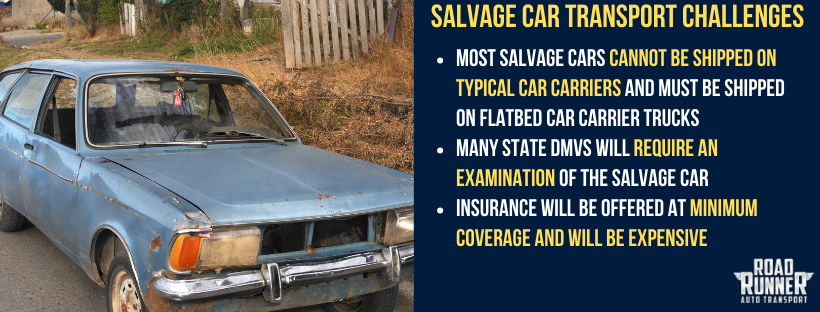
- Inoperable Condition – Almost all salvage cars are not drivable, which means they cannot be shipped on regular car carriers that require vehicles to be driven onto the truck.
- Flatbed Shipping Required – With an inoperable salvage car, you will be forced to ship on a flatbed auto transporter. The car will be placed onto the carrier by a forklift or, more typically, pulled on by a special motorized cable known as a winch.
- DMV Examination – You should be aware that most states require you to have a salvage car examined by the DMV to protect consumers and/or check for stolen parts or entire cars. This does not count as a vehicle inspection either.
- Limited Insurance Coverage – Additionally, you should know that many insurance companies will not offer complete coverage on scrap or rebuilt cars. Whatever coverage you can get will likely cost considerably more than it would for a typical running car or used vehicle.
- Potential Delays – The unique requirements for shipping salvage cars, such as flatbed carriers and additional inspections, can sometimes lead to longer shipping times and potential delays in the transportation process.
Understanding the limitations and additional steps involved can help you navigate the shipping process more effectively and ensure that your salvage or damaged vehicle reaches its destination safely. For a vehicle to be shipped on an open-air car carrier or in an enclosed car carrier, it must be driven on to both of those types of carrier trucks. So, with an inoperable salvage car, you will be forced to ship on a flatbed carrier.
Cost of Salvage Car Transport
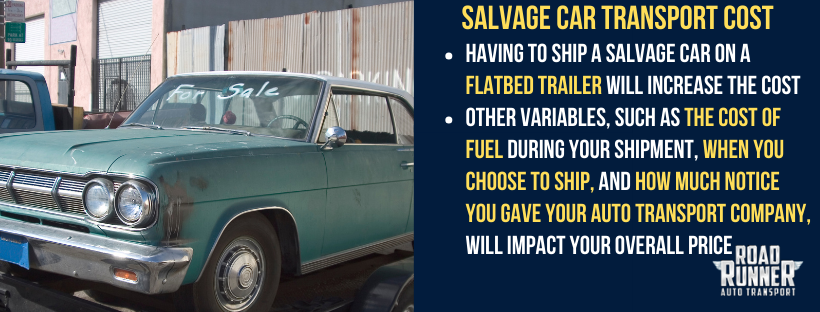
The cost of shipping a salvage car will vary based on individual factors. The shipping process will usually be more expensive than for running cars. As we mentioned, most salvage cars cannot be shipped on typical car carriers and must be shipped via less common methods. You can expect the overall cost of shipping a salvage car to cost between $0.50 and $1.50 per mile in 2024.
Tips for Inoperable Vehicle Transport
Not every salvage car will be undrivable (otherwise called “inoperable”), but most will be. If the salvage or damaged vehicle that you are shipping is, in fact, inoperable, the process will be a bit different.
Use the following tips to experience a smooth and safe transport of your undrivable salvage car:
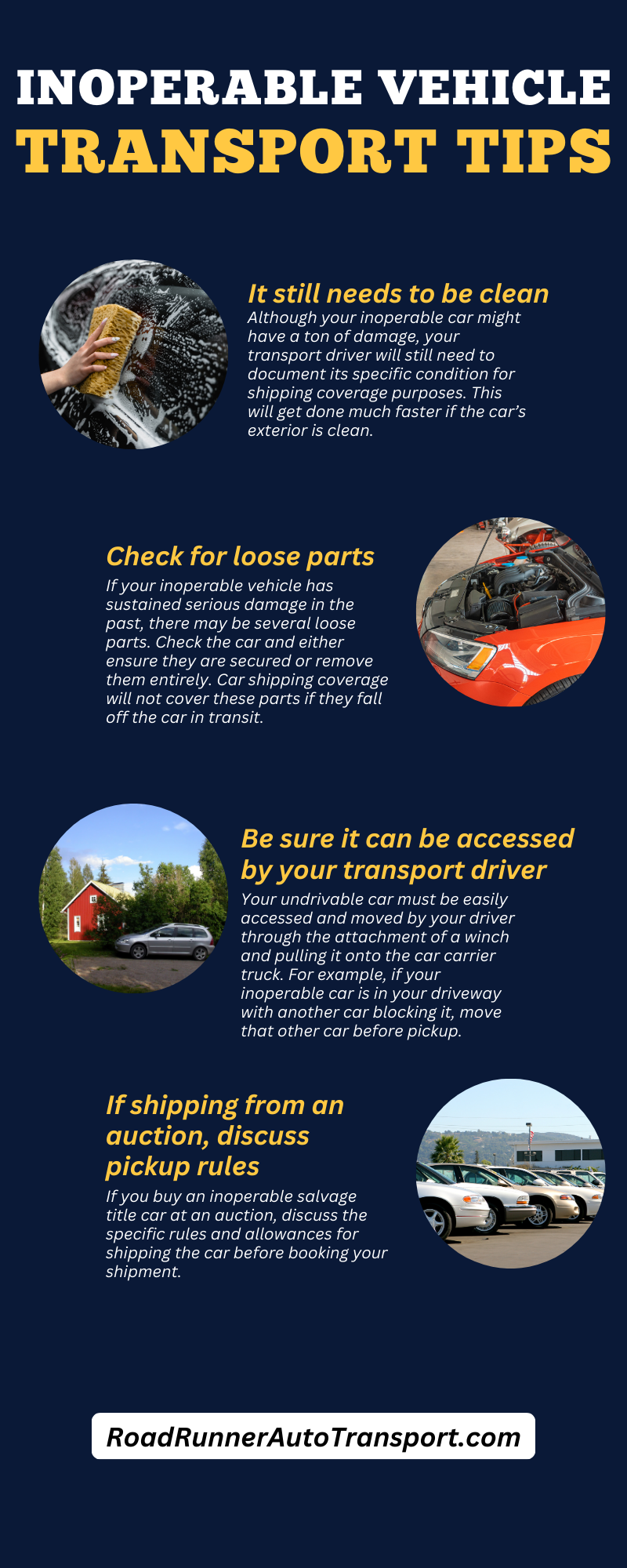
- Clean Before Pickup – Although your salvage car might be smashed up and/or have tons of dents, scratches, and chips, you will still need to clean the exterior before pickup. Your car shipping driver will still have to perform a visual inspection of the exterior so that they can take note of all the preexisting damage.
- Check for Loose Parts – If the inoperable car you are shipping has serious damage from an accident, check it very carefully for loose parts before shipping it. These parts can fall off when the vehicle is in transit, so you must pay to replace them.
- Winch Attachment Location – The car carrier truck must be able to access the totaled car wherever it is being shipped. For example, if it is in a garage, you must find a way to move it out.
- Auction Transport Pickup Rules – The auction that you ship your salvage car from might have certain rules that could impact the pickup of your shipment. For example, they might require that they tow the salvage car you bought from their lot to somewhere in front of the auction before you ship it or tow it the rest of the way home yourself.
Streamlining Salvage Car Transport with RoadRunner
Purchasing a salvaged car can be useful for restoration or parts, but there are several challenges to consider when buying a wrecked car at an auction. These include transporting the car from the auction, obtaining insurance if you plan to repair and drive it, getting accurate vehicle histories, and dealing with additional state-specific requirements.
To simplify the process of getting the salvaged vehicle home from an auction, consider shipping it with RoadRunner Auto Transport by calling (888) 777-2123 anytime, which can help you avoid the stress of towing it yourself.
FAQ
How do you ship a salvage car?
You can ship a salvage car by simply contacting a car shipping company like RoadRunner and giving them all the details of your shipment. After that, your auto transport company will take care of the rest of the process for you, except for a few easily completed steps of preparation required on your part.
How are cars that won’t start shipped?
Cars that won’t start, otherwise known as inoperable or undrivable cars, are shipped on flatbed car carriers. Regular open car carriers and enclosed car carriers require a car to be able to be driven onto the trailer. With a flatbed car carrier, inoperable cars can be placed onto the trailer using either a forklift or a winch.
Is it worth buying a car with a salvage title?
Buying a car with a salvage title can be worth it if you can successfully rebuild the entire vehicle and sell it for a profit. The purchase of a vehicle with a salvage title can also be worth it if you intend to strip what remains for parts and sell them for a profit.
Is totaled car transport more expensive?
Totaled car transport tends to be more expensive than typical car transport because totaled cars cannot be shipped on open or enclosed car carriers. Thus, they must be shipped on special flatbed car carriers, which are more expensive to ship on because they are much shorter in supply and can only ship one to four cars, whereas typical car carriers can ship more than ten vehicles at a time.
Instant Car Shipping Quote
Calculate your car shipping rate in 3 easy steps!
Salvage Car Transport Solutions: How To Ship Wrecked Cars In 2024
Posted on 11/21/2023
Table of Contents:
Salvage Auto Transport Basics
A salvage car is a car that has very little or no financial value due to damage incurred from car accidents, floods, fires, or theft. With a salvage car, the insurance company has deemed the cost of repairs to be equal to or greater than the cost of buying an equivalent new or used vehicle.
Salvage Car Details
There are several things to consider before looking for salvage cars for sale. People might be interested in buying a salvage car for various reasons, such as restoration for personal use or profit, using or selling the parts, or providing a vehicle for a first-time driver in the family.
Here are some key points to keep in mind:
- Restoration Purposes – Some people plan to restore a salvage car for their personal use later or to sell it for a profit after the restoration is complete.
- Parts Sourcing – Auto shops may purchase salvage cars if they think they can sell or use some of the parts.
- First-Time Driver – Some people buy salvage cars for use by a first-time driver in their family, such as a teenager, as a cost-effective option.
- Inoperable Condition – It must be driven onto both of those types of auto transporters. So, with an inoperable salvage car, you will be forced to ship on a flatbed carrier.
- Unique Shipping Requirements – Salvage cars often have specific transportation needs that differ from running vehicles, such as requiring flatbed shipping and additional inspections, which can lead to longer shipping times and potential delays.
When considering purchasing a salvage car, it’s smart to understand the reasons behind the decision and the unique challenges that come with owning and transporting these vehicles with an auto transport company. Being aware of these factors can help you make informed choices and plan accordingly.
Challenges of Salvage Car Shipping
When shipping a salvage car, it’s smart to be aware of the individual challenges and requirements that come with the process. Salvage vehicles often have specific transportation needs that differ from those of running cars, and understanding these differences can help you make informed decisions and ensure a smoother shipping experience.
Here are some of the challenges you may face when shipping a salvage car:
- Inoperable Condition – Almost all salvage cars are not drivable, which means they cannot be shipped on regular car carriers that require vehicles to be driven onto the truck.
- Flatbed Shipping Required – With an inoperable salvage car, you will be forced to ship on a flatbed auto transporter. The car will be placed onto the carrier by a forklift or, more typically, pulled on by a special motorized cable known as a winch.
- DMV Examination – You should be aware that most states require you to have a salvage car examined by the DMV to protect consumers and/or check for stolen parts or entire cars. This does not count as a vehicle inspection either.
- Limited Insurance Coverage – Additionally, you should know that many insurance companies will not offer complete coverage on scrap or rebuilt cars. Whatever coverage you can get will likely cost considerably more than it would for a typical running car or used vehicle.
- Potential Delays – The unique requirements for shipping salvage cars, such as flatbed carriers and additional inspections, can sometimes lead to longer shipping times and potential delays in the transportation process.
Understanding the limitations and additional steps involved can help you navigate the shipping process more effectively and ensure that your salvage or damaged vehicle reaches its destination safely. For a vehicle to be shipped on an open-air car carrier or in an enclosed car carrier, it must be driven on to both of those types of carrier trucks. So, with an inoperable salvage car, you will be forced to ship on a flatbed carrier.
Cost of Salvage Car Transport
The cost of shipping a salvage car will vary based on individual factors. The shipping process will usually be more expensive than for running cars. As we mentioned, most salvage cars cannot be shipped on typical car carriers and must be shipped via less common methods. You can expect the overall cost of shipping a salvage car to cost between $0.50 and $1.50 per mile in 2024.
Tips for Inoperable Vehicle Transport
Not every salvage car will be undrivable (otherwise called “inoperable”), but most will be. If the salvage or damaged vehicle that you are shipping is, in fact, inoperable, the process will be a bit different.
Use the following tips to experience a smooth and safe transport of your undrivable salvage car:
- Clean Before Pickup – Although your salvage car might be smashed up and/or have tons of dents, scratches, and chips, you will still need to clean the exterior before pickup. Your car shipping driver will still have to perform a visual inspection of the exterior so that they can take note of all the preexisting damage.
- Check for Loose Parts – If the inoperable car you are shipping has serious damage from an accident, check it very carefully for loose parts before shipping it. These parts can fall off when the vehicle is in transit, so you must pay to replace them.
- Winch Attachment Location – The car carrier truck must be able to access the totaled car wherever it is being shipped. For example, if it is in a garage, you must find a way to move it out.
- Auction Transport Pickup Rules – The auction that you ship your salvage car from might have certain rules that could impact the pickup of your shipment. For example, they might require that they tow the salvage car you bought from their lot to somewhere in front of the auction before you ship it or tow it the rest of the way home yourself.
Streamlining Salvage Car Transport with RoadRunner
Purchasing a salvaged car can be useful for restoration or parts, but there are several challenges to consider when buying a wrecked car at an auction. These include transporting the car from the auction, obtaining insurance if you plan to repair and drive it, getting accurate vehicle histories, and dealing with additional state-specific requirements.
To simplify the process of getting the salvaged vehicle home from an auction, consider shipping it with RoadRunner Auto Transport by calling (888) 777-2123 anytime, which can help you avoid the stress of towing it yourself.
FAQ
How do you ship a salvage car?
You can ship a salvage car by simply contacting a car shipping company like RoadRunner and giving them all the details of your shipment. After that, your auto transport company will take care of the rest of the process for you, except for a few easily completed steps of preparation required on your part.
How are cars that won’t start shipped?
Cars that won’t start, otherwise known as inoperable or undrivable cars, are shipped on flatbed car carriers. Regular open car carriers and enclosed car carriers require a car to be able to be driven onto the trailer. With a flatbed car carrier, inoperable cars can be placed onto the trailer using either a forklift or a winch.
Is it worth buying a car with a salvage title?
Buying a car with a salvage title can be worth it if you can successfully rebuild the entire vehicle and sell it for a profit. The purchase of a vehicle with a salvage title can also be worth it if you intend to strip what remains for parts and sell them for a profit.
Is totaled car transport more expensive?
Totaled car transport tends to be more expensive than typical car transport because totaled cars cannot be shipped on open or enclosed car carriers. Thus, they must be shipped on special flatbed car carriers, which are more expensive to ship on because they are much shorter in supply and can only ship one to four cars, whereas typical car carriers can ship more than ten vehicles at a time.

RoadRunner Auto Transport Reviews
“RoadRunner Auto Transport did an excellent job shipping a car that I bought online. I spoke with multiple car shipping companies, but the folks at RoadRunner were the most helpful.”
 Henry DNew Orleans, LA
“RoadRunner is the best auto transport company that we've used so far. The agent that we spoke with was very friendly and helpful. Our car was delivered on time and in perfect condition.”
Bruce YKansas City, KS
“When I needed to ship my car, I wanted to find the most reliable auto transport company possible. After calling around, I chose RoadRunner and couldn't be happier with the service they provided.”
Daniel AWhittier, CA
“I'm very happy with the service I received from RoadRunner Auto Transport. They picked up my car right from my home and I was able to track my automobile transport online very easily.”
Luis CSyracuse, NY
“I was looking for cheap car shipping quotes and RoadRunner provided me with a very fair price. The driver was friendly and my car delivery was on time with no issues. 5 star auto shipping service!”
Tara KPhiladelphia, PA
"The driver was professional and courteous. Very pleased with my entire experience with RoadRunner Auto Transport."
Sally D.
Atlanta, GA


"Super professional and helpful from the very first call. Easy to book online and the rate was better than I expected."
Steven F.
Austin, TX

"The RoadRunner agent we spoke with answered all of our questions and kept us in the loop throughout the shipment."
Christopher G.
Cincinnati, OH

"From the time of quote to the pick up of my vehicle and the delivery there was a very good communication."
Andres M.
Oakland, CA

Frequently Asked Questions
Get answers to some of the most commonly asked questions about the vehicle transportation process.